The Nuclear Option: How Meta Is Securing 6.6 GW to Power the AI Future


I have been tracking the trajectory of Artificial Intelligence for years, and if there is one thing I have learned, it is this: Intelligence requires power. And I don’t mean political power; I mean raw, unadulterated electricity.
For a long time, the tech industry tried to convince us (and perhaps themselves) that wind and solar would be enough to power the digital revolution. But as I look at the sheer scale of the data centers rising from the ground today, it’s clear that the equation has changed.
This week, Meta—Mark Zuckerberg’s empire—dropped a bombshell that confirms what I have suspected for a while. They aren’t just buying energy anymore; they are fundamentally reshaping the American energy grid. Meta has signed agreements to secure a staggering 6.6 gigawatts (GW) of nuclear energy capacity by 2035.
To put that into perspective, 6.6 GW is roughly the output of six or seven standard nuclear reactors. It is enough to power millions of homes. But Meta isn’t powering toaster ovens; they are powering the brains of the future.
Here is my deep dive into what this deal means, why “baseload” is the new buzzword, and why the atom is making a comeback in Silicon Valley.
Why Solar and Wind Just Aren’t Cutting It
I love renewable energy. Seeing solar farms glisten in the desert is fantastic. But here is the hard truth about training massive AI models like Llama 4 or 5: They do not sleep.


An AI data center operates at peak capacity 24 hours a day, 7 days a week.
- Solar goes away when the sun sets.
- Wind stops when the air is still.
This intermittency is a nightmare for a supercomputer that needs a steady, flat line of power—what engineers call “baseload power.” Until battery technology makes a quantum leap, nuclear is the only carbon-free source that provides that kind of reliability at this scale.
Meta’s move tells me that they are done taking risks with grid stability. They are building their own energy fortress.
The Three Titans: Who Is Meta Partnering With?
I dug into the details of the announcement, and this isn’t a single contract. It’s a strategic alliance with three major players, each bringing something different to the table.
1. TerraPower: The Bill Gates Connection
This is the part that excites the tech geek in me. Meta is backing TerraPower, a company founded by Bill Gates, to deploy their Natrium technology.
- The Tech: These aren’t your grandfather’s reactors. Natrium reactors use liquid sodium for cooling instead of water, which makes them safer and more efficient.
- The Plan: They are aiming to bring two units online by 2032, providing about 690 MW.
- My Take: This is a bet on innovation. Meta is essentially funding the R&D of next-gen nuclear physics.
2. Oklo: The Futuristic Campus
If TerraPower is the heavy hitter, Oklo is the agile disruptor.
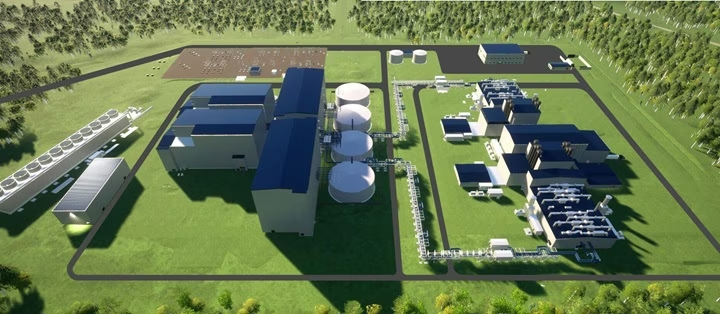
- Meta and Oklo are planning a massive nuclear campus capable of generating 1.2 GW by 2030.
- They use the “Aurora Powerhouse” design—fast reactors that can actually run on recycled nuclear fuel.
- I find this fascinating because it solves two problems at once: it generates power and reduces nuclear waste.
3. Vistra: The Muscle on the Ground
While the other two are building the future, Vistra is handling the present.
- Meta signed 20-year agreements to pull over 2.1 GW from Vistra’s existing nuclear fleet.
- They are also funding physical upgrades to these plants to squeeze out every last megawatt of capacity.
The “Prometheus” Factor: Why Ohio?

All of this energy has a destination. A significant portion is headed to the Midwest, specifically to support Meta’s Prometheus supercluster in Ohio.
I have written before about how geography is destiny in the AI race. Ohio is rapidly becoming the silicon heartland, not because of the weather, but because of the grid potential. By situating Prometheus there and feeding it with nuclear power, Meta is creating an AI training ground that is immune to oil price shocks or weather patterns.
What This Means for the Future of Tech

Reading between the lines, I see a few major shifts happening:
- Big Tech is Becoming Big Energy: Amazon bought a nuclear-powered data center campus earlier this year. Microsoft is restarting Three Mile Island. Now Meta is doing this. These companies are effectively becoming utilities.
- The End of “Greenwashing”: This isn’t about buying carbon credits to look good. This is about physical infrastructure. It’s a recognition that the digital world has a very heavy physical footprint.
- A Nuclear Renaissance: After decades of stagnation, the demand from AI is single-handedly reviving the US nuclear industry.
Final Thoughts
I used to think the bottleneck for AI would be chips—getting enough H100s from Nvidia. But as I watch these mega-deals unfold, I’m realizing the real bottleneck is the plug in the wall.
Meta’s 6.6 GW gamble is a statement: They believe the AI revolution is just getting started, and they are willing to split atoms to ensure they stay at the front of the pack.
It’s bold, it’s expensive, and honestly? It’s exactly what I would do if I were them.
What do you think? Is it right for tech companies to consume this much of the nation’s energy capacity, or is this the necessary cost of progress? Let’s talk in the comments.
You Might Also Like;